

A single 😊 can make a message feel warmer, or leave you staring at your phone, wondering what the sender really meant.
In my experience, the emoji usually signals friendliness, gratitude, gentle happiness, or an attempt to make a short text sound kinder. “Thanks for helping 😊” reads like genuine appreciation.
But place the exact same face after “Okay” in the middle of an argument, and it can feel restrained, dismissive, or harder to interpret.
Buy an Established Instagram Account
Skip starting from zero. Browse Instagram/TikTok accounts with audiences across many niches.
See Available AccountsThat is why 😊 does not have one fixed meaning. The sentence, what happened earlier in the conversation, and the sender’s normal texting style usually matter more than the yellow face itself.
What Does 😊 Mean?
😊 is officially called **Smiling Face with Smiling Eyes**. Its closed smile, curved eyes, and rosy cheeks make it feel warmer and gentler than a plain smiley face.
In most messages, it signals friendliness, gratitude, contentment, or quiet happiness. It can also make a short reply feel less abrupt.
It often means something close to:
- “Thank you. I appreciate this.”
- “I’m happy for you.”
- “I mean this kindly.”
- “I don’t want this brief message to sound cold.”
- “I saw your message and am acknowledging it warmly.”
It is usually softer than 😄, less playful than 😁, and less openly affectionate than 🥰. Its exact meaning still depends on the sentence, the relationship, and what happened earlier in the conversation.
The Most Common Uses
Most of the time, 😊 does not change the message completely; it changes its tone. It gives a thank-you a little more warmth, makes good news feel gentler, or stops a short reply from looking abrupt. Here is what that looks like in everyday messages.
Warmth and appreciation
This is the most straightforward use. 😊 makes a thank-you, good wish, or congratulation feel a little more personal.
- “Thanks for helping me with that 😊”
- “I’m really happy for you 😊”
- “Hope your appointment goes well 😊”
In each example, the words already communicate something positive. The emoji reinforces that tone.
A softer short reply

People also add 😊 to messages that might otherwise look abrupt.
- “Got it 😊”
- “See you tomorrow 😊”
- “No problem 😊”
The emoji can signal that the sender is not annoyed or dismissive. It is a small cue of goodwill, especially when the message is only two or three words long.
Quiet happiness
😊 can express happiness without the high-energy feeling of 😄, 😆, or 🎉.
- “I got the job 😊”
- “We finally booked the trip 😊”
- “That made my day 😊”
It often feels like a pleased smile rather than loud celebration.
Polite acknowledgment
In work chats and conversations with acquaintances, 😊 may act like a written nod.
- “Thanks for sending this over 😊”
- “Noted, see you at 10 tomorrow 😊”
- “I received the document, thank you 😊”
This works best when the topic is routine and the sender already uses a casual, friendly tone.
When 😊 Can Feel Different
😊 is not automatically sarcastic or passive-aggressive. Still, it can be read that way when the surrounding words and situation are tense.
- “That’s fine 😊”
- “Sure, I’ll do it 😊”
- “Okay 😊”
In a relaxed conversation, these may be completely harmless. After criticism, an argument, or an unanswered question, they can feel unclear. The recipient may wonder whether the sender is truly okay or is using the smile to hide frustration.
That is not because 😊 secretly means “I am angry.” It happens because short replies leave too much room for interpretation.
If you need to respond to something serious, say more than the emoji:
- “Okay, I understand what you mean.”
- “I see why that upset you. Thank you for explaining.”
- “I’m not fully comfortable with that, but I can discuss it.”
Clear language is more reliable than trying to make a difficult message sound lighter with a smile.
What Does 😊 Mean in a Reply? Read the Words Around It
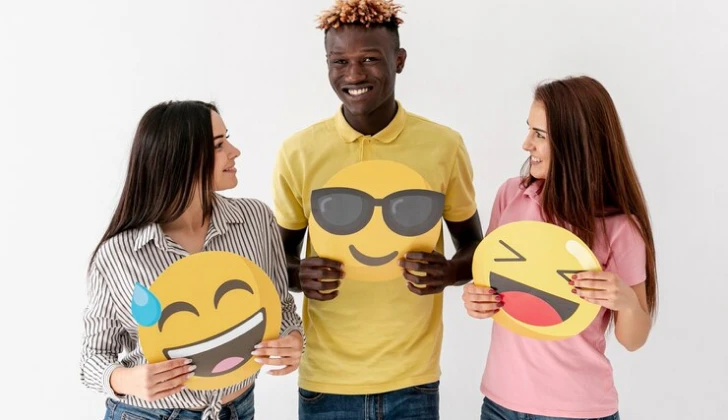
| If they wrote | Most likely reading | What makes it different |
| “Thanks 😊” | Warm appreciation | The words are explicitly positive. |
| “No problem 😊” | Friendly reassurance | It softens a short, practical reply. |
| “Okay 😊” | Acknowledgment; sometimes unclear | It can mean “sounds good,” but after tension it may feel like a conversation closer. |
| “Sure 😊” | Agreement; possibly restrained agreement | Prior disagreement or a vague request can make it feel less enthusiastic. |
| “That’s fine 😊” | Acceptance, or an attempt to remain polite | It is most ambiguous after disappointment or conflict. |
| “Goodnight 😊” | Warm sign-off | It may be affectionate, but it does not prove romantic interest. |
| “You looked great 😊” | A warm compliment; potentially flirty | The compliment creates the romantic possibility, not the emoji alone. |
Does 😊 Mean Someone Is Flirting?
Not by itself. 😊 appears in messages between friends, relatives, colleagues, customers, and romantic partners.
The words around it are what create a flirty tone.
| Message | Likely reading | Why |
| “Thanks for your help 😊” | Friendly appreciation | The message is a normal thank-you. |
| “You looked amazing today 😊” | Possibly flirty | The compliment creates the romantic possibility. |
| “I had such a good time with you 😊” | Warm; possibly romantic | The meaning depends on the setting and relationship. |
| “Good luck tomorrow 😊” | Supportive | It is a kind wish, not a romantic signal on its own. |
| “Okay 😊” | Ambiguous | Context determines whether it is friendly, neutral, or tense. |
If you are trying to gauge someone’s interest, pay attention to behavior across the conversation:
- Do they ask questions and remember your answers?
- Do they start conversations themselves?
- Do they follow up after spending time with you?
- Do they suggest concrete plans?
Those are more meaningful signs than one smile emoji.
How to Reply to 😊 Without Overthinking It
If the message is friendly, reply to the words, not the emoji.
- “Thanks 😊” → “You’re welcome, happy to help.”
- “Good luck tomorrow 😊” → “Thank you, I appreciate it.”
- “I had a good time 😊” → “Me too. I’d like to do it again.”
- “Okay 😊” after a difficult conversation → “Just checking: are we okay, or would you like to talk about it more?”
You do not need to mirror 😊. Use the tone you genuinely want to communicate. If the message feels unclear and the relationship matters, a direct question is more reliable than trying to decode a single emoji.
😊 vs. 🙂: What Is the Difference?

😊 and 🙂 look similar, but they do not always create the same impression. 😊 usually feels warmer and more openly kind, while 🙂 can feel neutral, careful, or slightly restrained. Like many emoji meanings in texts, the difference is not absolute. The words around the emoji and the sender’s usual style still matter.
| Emoji | Common tone | Typical example |
| 😊 | Warm, gentle, grateful, kind | “Thanks again for your help 😊” |
| 🙂 | Neutral, polite, restrained | “I understand 🙂” |
| ☺️ | Soft, sweet, slightly old-fashioned to some users | “That’s lovely ☺️” |
| 😄 | Clearly happy and enthusiastic | “We got the tickets 😄” |
| 😁 | Playful, energetic, excited | “I can’t wait for Friday 😁” |
| 🥰 | Affectionate and emotionally warm | “You made my day 🥰” |
A simple comparison:
- “No problem 😊” usually feels warm and relaxed.
- “No problem 🙂” may feel polite, neutral, or slightly formal.
Neither reading is universal. Emoji habits vary from person to person. If someone uses 🙂 frequently, it may be completely sincere. If they never use emojis, either one may feel more deliberate.
😊 vs. ☺️: What Is the Difference?
Both emojis can communicate gentle happiness, but they do not always feel identical. 😊 has rosy cheeks and smiling eyes, so it often reads as warmer, more appreciative, or slightly bashful.
☺️ is a simpler smiling face that can feel softer, more classic, or more understated. For example, “That’s so kind of you 😊” may suggest warmth or being touched. “That’s so kind of you ☺️” may feel gentle and sweet, but less expressive.
Using 😊 at Work
😊 can work in professional messages when the relationship and workplace culture are already reasonably casual.
Appropriate examples:
- “Thanks for sending the revised file 😊”
- “Looking forward to speaking tomorrow 😊”
- “I appreciate the quick update 😊”
Use it sparingly. One emoji is normally enough. If your workplace is very formal, a clear sentence without an emoji is often the safer choice.
Avoid 😊 in messages involving:
- Rejection or disappointing news
- Performance feedback
- Conflict or complaints
- Layoffs, missed deadlines, or serious errors
- Sensitive personal information
For example:
“Your request was declined 😊”
creates a tone mismatch. The emoji may make the message seem dismissive rather than kind.
A better version is:
“I’m sorry, but we can’t approve this request at this time. Here is what you can do next…”
What 😊 Means on Snapchat
When 😊 appears beside someone’s name on Snapchat, it is a Friend Emoji rather than a reaction to their latest message. It means that person is one of your Best Friends: you send a lot of Snaps to each other, but they are not your #1 Best Friend.
Inside a Snapchat chat, 😊 usually works as it does in a text or DM: it adds a friendly, warm tone.
How to Avoid Misreading It
When you receive 😊, consider these questions before drawing a conclusion:
- What do the words say without the emoji?
The sentence usually carries the main meaning. - What happened earlier in the conversation?
“Okay 😊” after a plan is different from “Okay 😊” after an argument. - How does this person normally text?
A frequent emoji user may send it automatically. For someone who rarely uses emojis, it may be more intentional. - Is there a pattern beyond one message?
Repeated attention, warmth, and effort say more than a single character. - Would a direct question clear things up?
If the relationship matters and the message feels ambiguous, ask rather than guessing.
Why 😊 May Not Be As Deliberate As It Looks
It is easy to assume that every emoji was chosen carefully, especially when the message comes from someone you like or when the conversation already feels uncertain. But sometimes 😊 is just a habit.
Some people use the same smile in nearly every friendly message. Others tap the first emoji their keyboard suggests. A coworker might add it to every “thank you,” while a friend may only use it when they genuinely feel touched or a little shy.
Before looking for a hidden meaning, compare the message with that person’s normal style. Do they use 😊 with everyone? Do they use lots of emojis in general? Or is this unusual for them? One emoji can add tone, but it rarely tells the whole story.
The stronger clues are usually the timing, the words they chose, whether they ask questions, and whether they make an effort to keep the conversation going.
Common Mistakes
😊 is easy to overread because the same emoji can appear in a thank-you, a compliment, or a tense reply. These are the assumptions most likely to lead you in the wrong direction.
- Treating it as proof of romantic interest
A warm emoji is not a confession. A person can use 😊 with almost anyone.
- Assuming it is always passive-aggressive
It can feel awkward in a tense exchange, but that does not mean the sender intended sarcasm. Text strips out voice and facial expression, so ambiguity is normal.
- Using it to soften serious news
A smile cannot fix the tone of a difficult message. Use clear, respectful wording instead.
- Forgetting that habits matter
Some people use emojis in every reply. Others barely use them. Their normal style is the best context you have.
Final Thoughts
In my experience, 😊 works best when it supports words that are already clear. I use it to make a quick “thank you,” “good luck,” or “that made me smile” feel warmer without making the message overly emotional.
It gets confusing when the reply is short and the conversation is tense. “Okay 😊” may be harmless, but after a disagreement, it can leave someone wondering whether everything is really fine.
That is why I do not read 😊 on its own. I look at the full exchange, the person’s usual texting style, and whether their actions match their words. When a message matters, clear wording should come first; the emoji should only support the tone.
Frequently Asked Questions
What does 😊 mean from a girl or guy?
Usually, it means warmth, friendliness, gratitude, or mild happiness. Its meaning does not reliably change based on the sender’s gender. Read the message, the relationship, and the larger conversation instead.
Is 😊 flirty?
It can be part of a flirty message, especially alongside compliments or clear interest. On its own, it is usually just friendly.
What does “thank you 😊” mean?
It normally means genuine appreciation with a warm or gentle tone.
Is 😊 passive-aggressive?
Not inherently. It may feel passive-aggressive when it follows a tense statement or appears in a very short reply, but the emoji alone does not prove intent.
What does “okay 😊” mean?
It may mean “sounds good,” “I understand,” or “I want to end this politely.” If the conversation is tense, it can be ambiguous, so look at the context.
Can I use 😊 in a professional message?
Yes, if your workplace uses a casual communication style and the message is positive or routine. Avoid it in serious, negative, or sensitive situations.

Emi Daniel
Buy an Established Instagram Account
Skip starting from zero. Browse Instagram/TikTok accounts with audiences across many niches.
See Available AccountsRelated articles
-
A Guide to Gen Z Emojis: Speak Their Language on Social Media
Emojis are more than fun add-ons for Gen Z. They can signal humor, irony, tone, and shared cultural references in a few characters. For brands and creators,…
17 min readEmi Daniel
-
Top 10 Apps Like Pinterest to Try for Free (2026 Guide)
Pinterest used to feel like flipping through someone’s real taste. Lately it feels more like scrolling past ads with a few actual pins mixed in, and a…
21 min read -
How to Increase Your Snapchat Score in 2026: Records, Strategies & Smart Tips
Snapchat Score is one of social media’s most mysterious features, and plenty of people check it every day just to see that number go up. At first…
15 min read