

With over 50 million content creators worldwide, finding the right partner can feel overwhelming. Influencer search tools make it easier to identify creators who align with your brand values, engage authentically, and drive measurable results.
The trick is using clever influencer research software far past the follow count. Branding influencers now use data-focused applications to identify, study, and build bonds with creators, enabling authentic content and measurable analytics.
Whether for making a worldwide push or kicking off the campaign to launch influencer marketing, the best tool sets can become your game-changer regarding strategy and facilitate discovering perfectly attuned brand collaborators.
Buy an Established Instagram Account
Skip starting from zero. Browse Instagram/TikTok accounts with audiences across many niches.
See Available AccountsIn this guide, we’ll break down the top influencer search platforms, from robust enterprise solutions to accessible tools for small teams, so you can build a scalable, strategic, and results-focused partnership strategy.
Understanding the Value of Influencer Marketing Partnerships
Partnering with influencers isn’t just about visibility; it’s about building authentic relationships that resonate deeply with your target audience.
Why Do Strategic Influencer Collaborations Drive Brand Growth?
When brands align with the right influencers, they tap into existing trust and credibility that no conventional advertising can match.
Research has shown that 61% of consumers trust influencer recommendations compared to just 38% who trust branded social media content. That trust also translates to ROI.
The key is to find influencers who already organically match your brand values and speak authentically to your consumer set.
For brands navigating influencer partnerships, understanding how an SMMA works on social media can provide valuable insights into campaign management and optimizing ROI.
Top Metrics to Track with Influencer Search Tools for Maximum ROI
Looking beyond follower counts is essential for successful influencer partnerships.
The most valuable metrics to consider include:
- Audience demographics: The age, location, gender, and interests of an influencer’s audience need to align with your target customers.
- Content quality: An influencer’s posts’ production value, creativity, and authenticity. This directly impacts how your brand will be presented.
- Posting consistency: Regular, predictable content output suggests professionalism and reliability.
- Brand alignment: Previous partnerships, personal values, and content themes should naturally complement your brand positioning.
- Growth trends: Is their influence increasing, stable, or declining? Sudden spikes might indicate purchased followers.
How to Identify the Right Influencer Fit for Your Brand? (Using Search Tools)
Make an in-depth profile of your ideal influencer partner. This will guide your search and enable you to spot the best individuals who match your brand’s goals.
Start by answering these questions:
- What audience do you want to reach? Define exact demographics, interests, and behaviors.
- What type of content showcases your product or service? Consider if you need video tutorials, beautiful photography, educational content, or genuine reviews.
- What values must the influencer embody? List non-negotiable characteristics that align with your brand personality.
- What is the size of an influencer suited for your goals? Nano (1K-10K followers), micro (10K-50K), macro (500K-1M), or celebrity (1M+)?
- What specific experience should they have? Industry experience, technical skills, or particular lifestyle experience can be suitable.
Just as successful brands rely on clearly defined content pillars to guide their messaging, creating a detailed influencer profile ensures every collaboration reinforces your brand’s core themes.
Essential Features of High-Quality Influencer Search Tools
Finding the right influencer is about pinpointing creators whose audience, style, and values perfectly align with your brand. High-quality search tools make this process smarter, faster, and more effective.
Advanced Filtering Options in Influencer Search Tools
The most powerful influencer search platforms let you simultaneously filter creators based on multiple dimensions. Look for tools that offer filtering by:
- Platform-specific metrics: Instagram engagement rate, YouTube average view duration, TikTok completion rate.
- Audience demographics: Age brackets, geographic locations, gender distribution, and income levels.
- Content categories: Primary topics, hashtags used, keywords in captions.
- Brand affinity: Previous brand collaborations, product mentions, competitor relationships.
- Value alignment: Causes supported, content themes, and communication style.
- Technical capabilities: Production quality, editing style, specific skills (like recipe development or makeup application).
Engagement Analytics in Influencer Search Tools
Surface-level metrics can be misleading or even manipulated.
Advanced influencer tools dig deeper to reveal the quality of audience relationships through these 5 factors:
- Comment sentiment analysis: Understanding whether audience feedback is positive, negative, or neutral.
- Engagement distribution: Identifying whether interactions come from the same small group of followers or represent broader audience participation.
- Engagement authenticity: Flagging suspicious patterns that might indicate purchased engagement.
- Growth trajectory: Showing natural versus unnatural audience growth patterns.
- Response rates: Measuring how actively influencers engage with their community through replies and follow-ups.
Demographic Insights from Influencer Search Tools
Understanding who you’ll reach through an influencer partnership is crucial for strategic marketing.
Leading platforms provide granular audience insights:
- Interest mapping: Visualizing the broader interest categories and affinities of an influencer’s audience.
- Geographical distribution: Pinpointing where followers are concentrated globally, nationally, or locally.
- Platform overlap: Identifying which other platforms the audience actively uses.
- Brand affinity: Revealing which brands the audience already follows and engages with.
- Shopping behavior: Providing insights into purchasing habits and price sensitivity.
10 Premium Influencer Search Tools and Discovery Platforms Worth Your Investment
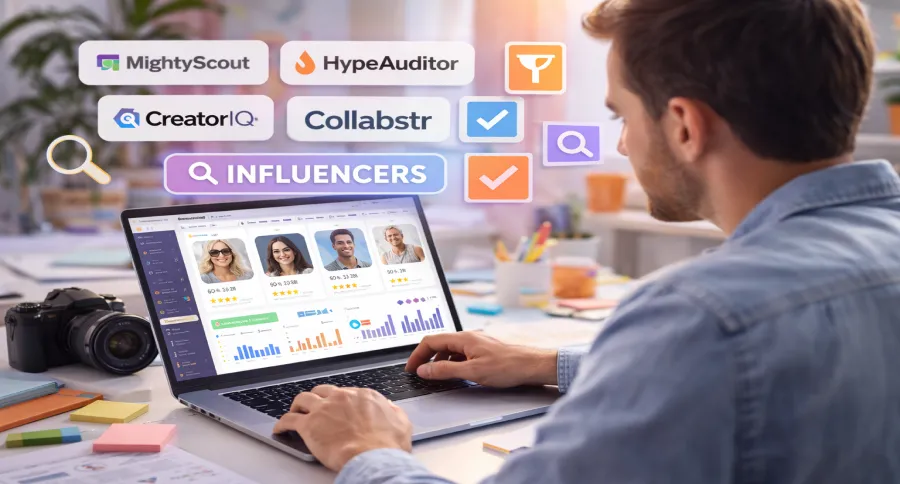
Choosing the right influencer discovery platform can make or break your marketing success.
These premium tools help you find, connect, and manage influencers efficiently, turning campaigns into long-term growth.
Upfluence
Upfluence stands out with its massive database of over 3 million influencers and advanced search technology.
The platform allows you to search by keyword, location, engagement rates, and audience interests.
Key strengths include:
- Live campaign tracking that provides real-time performance metrics.
- Integrated influencer relationship management tools.
- Direct outreach and payment processing within the platform.
- Audience overlap analysis to prevent reaching the same audiences repeatedly.
Upfluence is ideal for brands that have enduring influencer programs rather than one-off campaigns because its relationship management functionality optimizes extended partnerships.
The pricing starts at $500/month, which is within the means of mid-sized companies but offers enterprise-level features for larger brands.
Collabstr
Collabstr offers the world’s largest free influencer search tool, allowing brands to search for influencers and manage campaigns all in one place.
It supports multiple platforms, including Instagram, TikTok, YouTube, Twitter, Twitch, and Amazon, providing a comprehensive solution for influencer discovery and campaign management.
Key features:
- Free access to a vast influencer database.
- Multi-platform support for diverse influencer partnerships.
- Integrated campaign management tools.
It’s ideal for brands seeking a cost-effective solution for influencer discovery and campaign management across various platforms.
CreatorIQ
CreatorIQ applies AI to recommend flawless influencer partnerships based on your campaign objectives and past performance. Major brands like Unilever, H&M, and Disney utilize this business-to-business platform.
Standout features include:
- Predictive performance modeling that estimates campaign results.
- Automated fraud detection and audience quality verification.
- Integration with major e-commerce platforms for direct attribution.
- Customizable workflow management for team collaboration.
The platform’s strength lies in its data science approach to influencer selection, which removes much of the guesswork from partnership decisions. Its robust API also allows integration with your existing marketing stack.
While pricing is enterprise-grade (beginning at about $2,000/month), the ROI rationale is obvious for brands investing in influencers.
HypeAuditor
HypeAuditor has built its reputation on identifying fake followers and engagement. It is a goldmine for brands concerned about influencer fraud. The platform analyzes over 1,200 factors to verify authentic influence.
Its most valuable capabilities include:
- Detailed authenticity scores with transparent methodology.
- Historical performance analysis showing growth patterns.
- Audience interests and brand affinity mapping.
- Competitor influencer strategy analysis.
HypeAuditor offers a free search tool with limited functionality and premium plans starting around $399/month. Many brands use it as a verification layer before finalizing influencer partnerships identified through other platforms.
MightyScout
MightyScout is a versatile influencer marketing platform that provides a comprehensive suite of tools for influencer search, outreach, gifting, and analytics. While not an all-in-one solution, it offers a range of functionalities to support various aspects of influencer marketing campaigns.
Key features include:
- Influencer Search & Outreach: Identify and connect with influencers across platforms like Instagram, TikTok, and YouTube.
- Gifting Management: Manage product seeding and gifting campaigns efficiently.
- Analytics Dashboard: Monitor campaign performance and influencer engagement metrics.
- Affordable Pricing: Plans range from $99 to $749 per month, making it accessible for businesses of various sizes.
Ideal For: Brands seeking a cost-effective solution for influencer discovery and campaign management.
AspireIQ
AspireIQ (formerly Revfluence) approaches influencer discovery with a strong emphasis on content creation capabilities. The platform is particularly valuable for brands seeking high-quality visual assets beyond just promotional posts.
Key differentiators include:
- Content-first search based on aesthetic and creative style.
- Collaborative content approval workflows.
- Rights management for repurposing influencer content.
- Performance benchmarking against industry standards.
AspireIQ pricing starts around $1,000/month, but scales based on the number of influencer relationships managed.
Traackr
Traackr pioneered the enterprise influencer marketing platform category and continues to lead with its robust analytics and relationship management capabilities. The platform excels at managing complex, global influencer programs.
Notable features include:
- Brand safety and values alignment scoring.
- Competitive share of voice analysis.
- Integrated budget and contract management.
- Multi-market campaign coordination tools.
Traackr is geared toward advanced marketing organizations that operate large-scale influencer programs. In line with its feature-rich capabilities, pricing tends to start at $2,500/month for enterprise implementations.
Klear
Klear is different, with powerful psychographic targeting capabilities that are more sophisticated than mere demographics. The platform helps brands find influencers whose audience matches their ideal customer profile.
Standout features include:
- Psychographic audience segmentation is based on interests and behaviors.
- Visual influence scoring that quantifies visual impact.
- Historical content performance analysis.
- Transparent pricing structure for influencer negotiations.
Starting at around $450/month, Klear offers an excellent balance of sophistication and affordability for growing brands. Its interface is also much more intuitive than some of its enterprise competitors.
influData
influData allows brands to find and analyze influencers creating short-form content, providing a unique advantage in the growing short-video landscape.
Top features:
- YouTube Shorts Search: Exclusive focus on YouTube Shorts influencers, enabling brands to tap into the short-form content trend.
- Influencer Analysis: Provides detailed analytics on influencer performance, helping brands make informed decisions.
- Content Discovery: Facilitates the discovery of trending content, allowing brands to stay ahead of the curve.
It’s perfect for brands looking to leverage the popularity of short-form content on YouTube Shorts and connect with influencers in this niche.
NeoReach
NeoReach’s enterprise-level platform, which focuses on measurable campaign outcomes and attribution, powers leading brands like Amazon, Airbnb, and Walmart.
Key strengths include:
- Advanced ROI modeling and attribution methodology.
- Competitive intelligence on influencer partnerships.
- Audience overlap analysis across multiple influencers.
- Custom API integrations for marketing stack connectivity.
While primarily serving enterprise clients with custom pricing, NeoReach offers some of the industry’s measurement capabilities for brands investing heavily in influencer marketing.
Free and Budget-Friendly Influencer Search Options
Native search features on popular social platforms can help you find relevant creators without breaking your budget.
Social Media Platform Native Search Capabilities
You don’t always need specialized software to begin identifying potential influencers. Each major social platform offers native discovery tools that, while limited, can be effectively leveraged:
Instagram: Use the Explore page and hashtag searches to find creators in your niche. Save profiles to collections for easier organization.
TikTok: The Discover page showcases trending creators, while the search function lets you explore hashtags relevant to your industry.
YouTube: Search relevant keywords and filter by view count, upload date, and rating to identify influential creators in your space.
Twitter: Advanced search operators like “min_retweets:” help identify users who consistently generate engagement in your topic area.
While these methods require more manual effort than dedicated platforms, they cost nothing and can yield surprisingly good results, especially for brands beginning with influencer marketing.
Use Hashtag Research
Strategic hashtag research can uncover potential influencer partners without expensive tools:
- Identify 10-15 highly relevant industry or niche hashtags
- Track which creators consistently appear in top posts for these tags
- Look for patterns of creators who generate above-average engagement
- Create a spreadsheet to track these potential partners
- Analyze their content for brand alignment and audience overlap
This approach requires time investment but can be remarkably effective, especially for discovering emerging talent before they command premium rates. Free tools like Display Purposes and All Hashtags can help identify relevant hashtags to monitor.
5 Affordable Tools for Startups and Small Businesses
- Heepsy: Starting at just $49/month, Heepsy offers surprisingly robust search capabilities across Instagram, YouTube, TikTok, and Twitter. Its filters include engagement rate, location, and audience demographics.
- SocialBakers: Their influencer marketing solution begins at around $200/month. It includes AI-powered recommendations and performance prediction, and the platform covers all major social networks.
- Modash: With plans starting at $99/month, Modash provides Instagram and YouTube influencer discovery, fraud detection, and audience insights that rival more expensive platforms.
- BuzzSumo: While primarily a content research tool, BuzzSumo’s influencer search function (available in plans starting at $99/month) helps identify authoritative voices in specific topic areas.
- Tagger Media’s Lite Plan: A streamlined version of their enterprise platform, starting around $300/month, offers solid discovery capabilities with engagement analytics and audience insights.
Step-by-Step Process to Evaluate Influencer Search Results
Narrowing down your influencer search results is crucial to finding creators who truly fit your brand. A careful review helps ensure alignment with your values and campaign goals.
Creating a Shortlist Based on Alignment with Brand Values
Once your search tools generate potential matches, apply these filtering steps to create your shortlist:
1. Review the last 20-30 posts for tone, style, and overall brand fit
2. Check for potentially controversial content that could pose brand safety issues
3. Assess whether their content approach aligns with your marketing objectives
4. Verify they haven’t promoted direct competitors recently (usually within 3-6 months)
5. Confirm their content resonates with your target demographic
6. Evaluate their communication style for professionalism and authenticity
This initial screening should narrow your list to candidates who align with your brand values and positioning. Document specific observations for each shortlisted influencer to reference during the outreach and negotiation phases.
Analyzing Content Quality and Audience Engagement Patterns
Look beyond basic engagement rates to understand the quality of audience relationships:
- Examine comment depth and authenticity. Are followers leaving thoughtful responses or just emoji reactions?
- Track engagement consistency across posts. Do certain content types consistently perform better?
- Assess response patterns. Does the influencer actively engage with comments?
- Evaluate storytelling capabilities. Can they craft compelling narratives around products?
- Check production quality against your brand standards. Does their visual style enhance your brand presence?
Assess Potential Reach vs. Actual Influence

To assess actual influence, look for:
- Evidence of past partnerships driving measurable results (case studies, testimonials).
- Comments indicating purchase intent or completed purchases.
- Community trust signals, like followers asking for advice or recommendations.
- Consistent performance across various content types and partnership styles.
- Audience demographic alignment with your buyer personas.
Creators with smaller but highly influenced audiences often deliver better campaign ROI than larger but less engaged followings.
Proven Strategies to Approach and Vet Influencers Effectively
Approaching influencers the right way is key to building successful partnerships. Personalized, genuine outreach sets the stage for strong connections and meaningful collaborations.
Crafting Personalized Outreach Messages That Get Responses
Generic outreach messages rarely receive responses from quality influencers who receive dozens of partnership inquiries weekly. To stand out:
- Reference specific content pieces you genuinely enjoyed, with details that prove you’ve viewed their work.
- Explain why you see a natural fit between their content approach and your brand values.
- Outline the mutual benefit beyond compensation, how the partnership serves its audience, and content goals.
- Keep initial outreach concise (under 200 words) while conveying personality and authenticity.
- Include a clear call to action with the following steps, whether scheduling a call or requesting a media kit.
Personalization demonstrates respect for the influencer’s work and dramatically improves response rates. Avoid template-feeling messages or anything that could be interpreted as spam.
Questions to Ask Before Finalizing Partnership Agreements
- Once conversations begin, ask these critical questions to ensure alignment:
- What metrics do you typically use to measure campaign success?
- Can you share examples of similar brand partnerships and their results?
- How do you ensure FTC compliance in sponsored content?
- What creative input do you typically want from brand partners?
- How would you naturally integrate our product/service into your content?
- Do you have any content exclusivity agreements with competitors?
- What is your process for content approval before publishing?
- What additional usage rights for created content are you comfortable with?
Red Flags to Watch for When Evaluating Potential Partners
Be alert to these warning signs that may indicate problematic partnerships:
- Engagement rates are significantly below platform benchmarks for their follower size.
- Sudden, unexplained follower growth spikes are visible in analytics tools.
- Reluctance to share basic audience demographics or engagement data.
- An overly standardized approach to brand integrations across different products.
- History of promoting questionable products or get-rich-quick schemes.
- Lack of transparency about other brand relationships.
- Unwillingness to provide performance reporting after campaigns.
- Resistance to reasonable content approval processes.
- Demands for payment terms are unusual in the industry (like 100% payment upfront).
While occasional red flags might be explainable, multiple warning signs typically indicate partners who won’t deliver the results you’re seeking.
How to Measure the Success of Your Influencer Search Strategy?
Measuring the success of your influencer search strategy is crucial to ensure you’re partnering with the right creators and maximizing your marketing ROI.
KPIs That Matter Most for Influencer Marketing ROI
Track these key performance indicators to measure the effectiveness of your influencer partnerships:
Engagement rate: Likes, comments, shares, and saves relative to follower count.
Reach and impressions: Total audience exposure compared to expectations.
Click-through rate: Percentage of viewers who take action on links.
Conversion rate: Proportion of clickers who complete desired actions.
Cost per acquisition: Total partnership cost divided by new customers acquired.
Audience growth: New followers attributed to the partnership.
Content efficiency: Performance of influencer content compared to brand-created assets.
Brand sentiment: Changes in perception measured through comments and social listening.
Tools for Tracking Campaign Performance Beyond Engagement
Combine these measurement approaches for comprehensive performance tracking:
- Custom UTM parameters on all influencer links to track traffic and conversions in Google Analytics.
- Unique discount codes or landing pages for each influencer to attribute sales directly.
- Pixel tracking for conversion path analysis when direct attribution isn’t possible.
- Social listening tools to measure brand mention lift during campaigns.
- Sentiment analysis to evaluate qualitative audience response.
- Pre/post brand lift studies for major campaigns to measure awareness impact.
- Instagram Insights and other native analytics for engagement metrics.
- Third-party tools like Dash Hudson or Later for benchmarking against industry standards.
The most sophisticated brands create customized measurement dashboards combining data from multiple sources for a complete performance picture.
How to Refine Your Influencer Search Process Over Time
Implement these practices to improve your influencer discovery continuously:
- Conduct post-campaign reviews documenting which influencer characteristics correlated with success.
- Maintain a database of previous partnerships with performance data to inform future selections.
- Test different influencer tiers and types to identify your brand’s sweet spot.
- Compare results across platforms to determine where your audience is most responsive.
- Refine your ideal influencer profile based on actual performance data, not assumptions.
- Schedule quarterly reviews of your influencer selection criteria to incorporate new learnings.
- Continuously benchmark your results against industry standards.
This systematic approach transforms influencer selection from subjective decisions to a data-driven strategy, improving results with each campaign cycle.
Conclusion
Long-term influencer partnerships are increasingly stronger than one-time collaborations, with more brand support, consumer trust, and ROI.
Through investments in sustained connections via ambassador schemes, campaign creation, and ongoing interaction, brands can develop authentic connections that produce genuine outcomes.
In the meantime, staying ahead of emerging influencer discovery technologies like AI performance prediction and cross-platform metrics keeps you ahead of the game in a rapidly evolving landscape.
With the right tools, criteria, and long-term strategy, your influencer program can deliver consistent, measurable results for your brand.
FAQs
What is the best tool for finding influencers?
Tools like Upfluence, HypeAuditor, and Modash are top choices; they let you filter by niche, engagement, audience demographics, and authenticity.
How to find a brand partnership?
Identify your target brands, research their previous collaborations, and reach out with a personalized pitch showing how your content aligns with their values and audience.
How do I find influencers for my brand?
Use influencer search tools like HypeAuditor, Modash, or Heepsy to filter creators by niche, location, and engagement metrics.
Are free influencer search tools effective?
Free tools like Heepsy offer basic features, but premium platforms provide more comprehensive data and advanced filters.
How do I find local influencers?
Search location-based hashtags, explore local brand collaborations, and use social listening tools to identify nearby influencers.

Emi Daniel
Buy an Established Instagram Account
Skip starting from zero. Browse Instagram/TikTok accounts with audiences across many niches.
See Available AccountsRelated articles
-
Best Influencer Marketing Software in 2026: Top Platforms to Grow Your Brand
Influencer marketing used to feel optional, something you tried after you’d “done” everything else. Now it’s often the first place customers hear about a brand. The problem…
18 min readEmi Daniel
-
The Ultimate Digital and Social Media Marketing Playbook: From Basic to Advanced Tactics
Are you tired of trying different methods and realizing your brand doesn’t get the attention it deserves? If so, you need to come up with the right…
23 min read -
Social Media Competitor Analysis: Tools, Benchmarks, and Strategy Guide
Are you getting fewer likes lately? You’re not alone. On Instagram, the average engagement dropped to about 0.45% in 2025, down 24% from last year. Still, the…
26 min read